Universal Dot Skates Guide: The Right Fit for Perfect Glide
Hello X-raypad Community,
Selecting the correct mouse feet is the first step to unlocking your mouse’s full potential. To eliminate the guesswork, we’ve created this straightforward guide based on precise specifications to help you make the perfect choice for an optimal glide.
Core Concept: Fewer Skates Can Mean Less Friction
A fundamental principle of physics applies here: a smaller total contact area between your mouse feet and the mousepad results in less sliding friction.
- For Speed & Less Resistance: If you prefer a faster, lower-friction glide, using fewer, correctly-sized skates (while ensuring mouse stability) is an effective approach.
- For Control & Stability: A larger contact area, achieved with bigger skates or a full set, provides more control and sharper stopping power.
Our Skate Models & Compatibility Guide
- Universal Dot Skates (6mm / 6.5mm) – The High-Compatibility Choice
- Best For: These sizes are compatible with almost all mice on the market, designed to fit standard skate grooves perfectly.
- Top Recommendation for: Critical for mice with precise skate requirements like the Logitech GPW (G Pro Wireless) and GPX 2c(G Pro X Superlight 2c) series. We recommend prioritizing 6mm or 6.5mm for these models to ensure a perfect fit and uninterrupted sensor performance.
- Universal Dot Skates (8mm) – Check Compatibility First
- Best For: Providing broad coverage on mice that can accommodate them.
- Important Note: This size is NOT suitable for mice with small skate grooves. Specifically, 8mm skates will NOT fit the GPW or GPX series and should be avoided for these models.
- Donut Skates (9.5mm) – For Large Grooves Only
- Best For: Delivering a seamless, unified glide on compatible mice
- Crucial Pre-requisite: These are designed exclusively for mice whose skate grooves have a diameter or length/width exceeding 9.5mm. Before purchasing, please use a ruler to accurately measure your mouse’s groove to confirm compatibility.
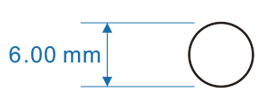 | Suitable for almost all mice, such as the GPW and GPX 2c. |
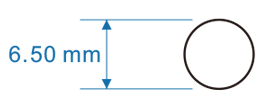 | Suitable for almost all mice, such as the GPW and GPX 2c. |
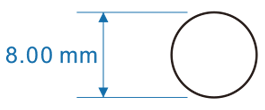 | Suitable for most mice, but not for mice with small feet slots, such as GPW and GPX 2c. |
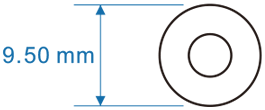 | Suitable for mice with large mouse feet slots (measurement required: diameter or length and width must be greater than 9.5 mm). |
Your Final Selection Strategy
A Quick Word on Materials
Size decides fit – material decides feel and lifespan. Four families, one line each:
- PTFE (Jade): the fastest, slickest glide. Great on cloth and glass, but on glass it wears like a consumable.
- Hardened PTFE (Obsidian): stronger stopping power and stable, controlled aim. Cloth and glass.
- UHMW-PE (Titanium U9, Obsidian Pro): the longevity king for glass pads – a unique textured, sandy feedback with outstanding wear resistance.
- Glass (Meteorite): extreme speed and virtually infinite life – cloth pads only, never on glass mousepads.
For the full material deep-dive, read PTFE vs Glass Skates: Which Material Wins for Your Mousepad?
Three Builds: Basic, Air and Ultra
Every material family comes in three internal builds:
- Basic – pure material plus adhesive. The lowest, most direct feel.
- Air – adds a noise-absorbing foam layer. Same glide, far less sound; a favorite among glass pad players who want speed without the scratchy noise.
- Ultra – adds an anti-collapse backing on top of the foam, so the skates keep their shape and feel even under heavy pressure.
In V2 batches, all three builds share a unified 0.85mm profile – swap between builds without re-adjusting to a new height, and your mouse’s tracking height (LOD) stays consistent.
One honest note from community testing: on cloth pads the three builds feel broadly similar, and the Air usually hits the best value point. On glass pads the differences become real – noise, texture feedback and pressure consistency all matter.
Break-In and Longevity: The Honest Part
New skates rarely feel their best on day one. Community long-term testing suggests:
- Hardened PTFE (Obsidian) starts slightly sticky – give it a deliberate break-in session before judging it.
- Foam-backed Air variants develop their final feel gradually over a few days of normal use.
- UHMW-PE (Titanium U9) needs the longest break-in – around 8–10 hours on glass – then blooms into its signature textured, sandy glide.
And the part most brands skip: PTFE is a consumable on glass pads. Under heavy daily use, expect to feel the glide change within a few weeks – replacing them regularly is effectively a subscription. If you play on glass every day, UHMW-PE costs more up front but pays for itself in lifespan: testers report weeks of 10+ hour days with no visible wear.
Dust note: a speck of dust won’t ruin your glide mid-game, but it adds noise – wipe your pad and dots occasionally with the included alcohol wipes.
- When Unsure, Choose Compatibility: For most users, especially those with popular models like the GPW/GPX, the 6mm or 6.5mm Universal Dot Skates are the safest and most compatible option.
- Measure for Larger Sizes: If you are considering 8mm dots or 9.5mm donuts, verifying your mouse’s groove dimensions is essential to avoid a poor fit.
- Fine-Tune Your Glide: You can experiment with the number of skates applied (while maintaining stability) to fine-tune the resistance and find your perfect balance between speed and control.
Summary:
The right choice starts with the right measurements. We hope this precise guide helps you make an informed decision for a superior gliding experience.FAQ
Are universal dot skates better than stock mouse feet?
They serve different needs. Model-specific skates match your mouse shell perfectly; universal dots fit almost any mouse and let you fine-tune glide by choosing the size, material and number of dots. For mice without dedicated skates – or for DIY tuning – dots are the answer.
How many dot skates should I use?
Most players use 4–8 dots. Fewer dots mean less contact area and less friction (faster); more dots distribute pressure and reduce any sticky feeling on textured pads. Keep the layout symmetrical for stability.
Do dot skates work on glass mousepads?
PTFE, hardened PTFE and UHMW-PE dots all work on glass. Glass (Meteorite) dots must never be used on glass pads – glass-on-glass causes permanent scratches. For daily glass use, UHMW-PE lasts far longer than PTFE.
How long do PTFE dot skates last on a glass pad?
Under heavy daily use, expect a noticeable glide change within 2–3 weeks – PTFE is a consumable on glass. UHMW-PE (Titanium U9) is the long-life alternative, with testers reporting weeks of heavy use with no visible wear.
Can I mix donuts and dots on the same mouse?
It’s your mouse – mixing is fine by us. For a consistent feel, keep heights equal and stick to one material across all contact points.
What size dots fit a Logitech GPW / GPX Superlight?
6mm or 6.5mm dots fit perfectly. Do not use 8mm dots on GPW/GPX series – the skate grooves are too small.
X-Raypad
No detail is too small for peak performance.


1 Response
[…] have been a tight squeeze, the 6.0mm dots you received will actually fit even easier. Refer to Xray-Pads dot skate guide for more details here. In this same store page, scroll down for the donuts which is what I recommended for the soft pad […]