
X-Raypad Mouse Skates Core Structure
To all enthusiasts who love studying peripheral structures, today we’ll use a diagram to break down the “core structure” of X-Raypad mouse feet. Understanding its structure will help you understand how different versions achieve vastly different tactile sensations.
The core structure, at a glance:
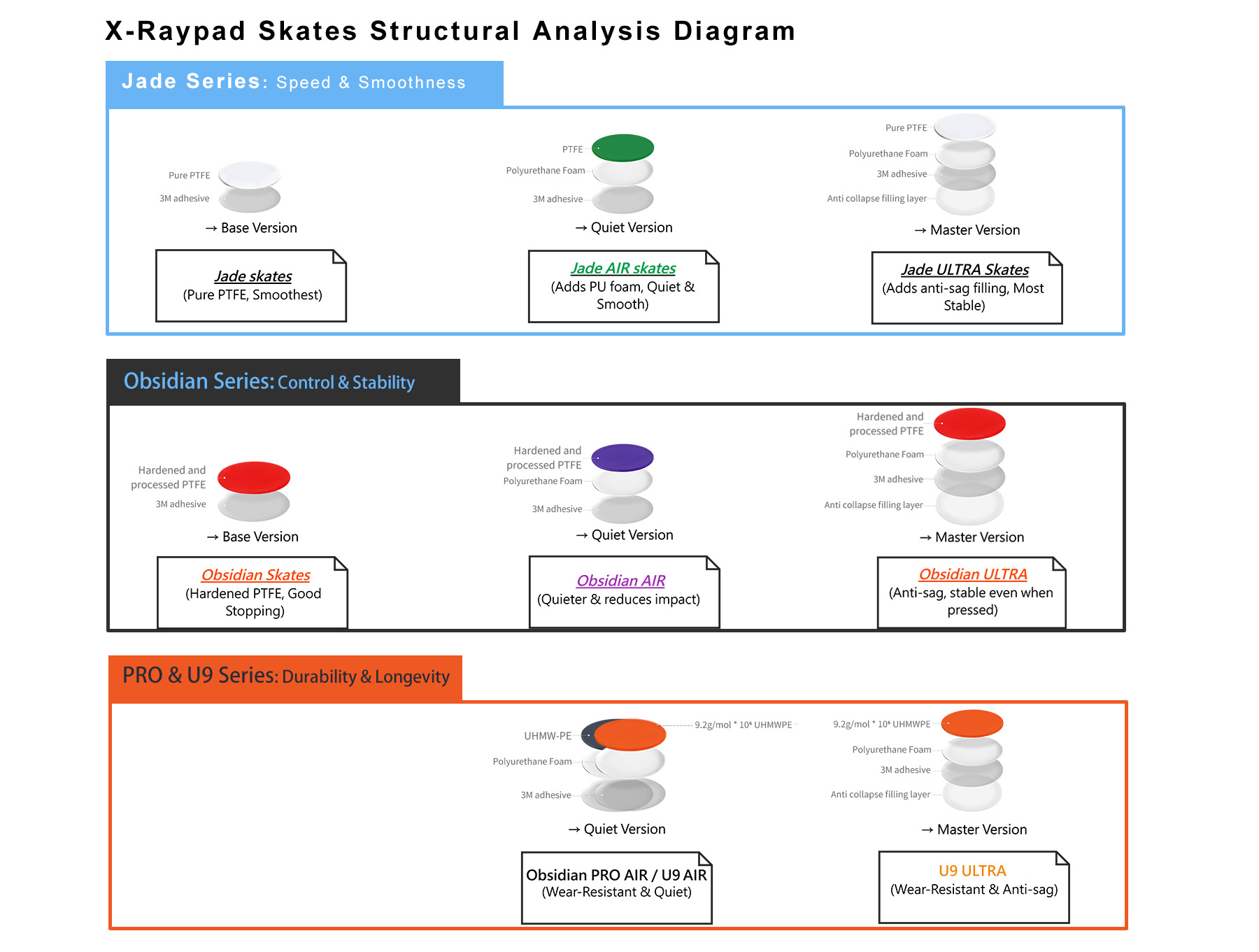
X-Raypad mouse feet are not simply “a piece of plastic,” but a precise layered system designed for precise control. All models are based on a clear structural logic, as shown in the diagram below:
Structure and Function Analysis of Each Layer:
1, Basic Model: Core Function Layer
This is the “body” of the mouse feet, determining the core feel and performance.
- Jade Series (Pure PTFE): Designed for extremely low friction and ultimate smoothness.
- Obsidian Series (Hardened PTFE): Designed for precise braking and accurate control.
- PRO/U9 Series (UHMW-PE): Building on control, this series elevates wear resistance to a new level.
2, AIR Series: Core Layer + Silent Layer (PU Foam)
- How to reduce noise? A layer of high-density PU foam is added beneath the core material. This elastic material effectively absorbs vibrations and impacts generated during mouse clicks and movements, transforming sharp collision sounds into muffled whispers, achieving physical noise reduction while providing a softer stopping feel.
3, ULTRA Series: Core Layer + Silent Layer + Stabilization Layer
- How to maintain stability? Building on the AIR structure, a special anti-collapse filler is injected into the foam layer. During high-intensity gaming, players often press down hard on the mouse. Ordinary mouse feet deform as a result, leading to sudden changes in friction area and force, resulting in an unstable feel. The ULTRA’s stabilization layer strongly resists deformation, ensuring that the contact surface and sliding feel of the mouse feet remain consistent whether you press down or not, providing an extremely stable operating foundation for competitive gaming.

